From probability to modern AI
How do counting and uncertainty become neural networks, transformers and diffusion models?
11 videos, about 6 h 19 min. Watch in order, or jump to a timestamp.
- 1
Introductory, Visual intuition, 7 min
Visualizing Probability and Combinatorics: The Counting Behind Chance
- Define probabilities by counting relevant outcomes.
- Recognize when counting by hand becomes impossible.
- Use combinatorics as a counting tool.
Jump to 0:52 the naive definition of probability, 2:19 why we need combinatorics
- 2
Introductory, Visual intuition, 15 min
Bayes theorem, the geometry of changing beliefs
- Recognize which facts are relevant to an estimate.
- Distinguish a base rate from a conditional probability.
- Update a probability using evidence.
Jump to 3:06 recognizing relevant facts, 3:55 working through the librarian example
- 3
Intermediate, Visual intuition, 10 min
Why “probability of 0” does not mean “impossible” | Probabilities of probabilities, part 2
- Notice the paradox of assigning probability to single real numbers.
- Locate probability in areas rather than heights.
- Understand why zero probability need not mean impossibility.
Jump to 1:28 the paradox of individual values, 4:31 what density units mean
- 4
Intermediate, Visual intuition, 31 min
But what is the Central Limit Theorem?
- Use a Galton board to introduce the normal distribution.
- Track how sums of random variables change shape.
- Understand the central limit theorem through repeated combination.
Jump to 0:20 the galton board and normal distribution, 1:09 going back to the basics
- 5
Introductory, Visual intuition, 19 min
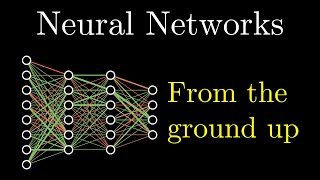
But what is a neural network? | Deep learning chapter 1
- Represent input pixels as neuron activations.
- Ask which parameters make a network expressive.
- Connect adjustable weights with a pattern-recognition task.
Jump to 3:19 activations from pixels, 8:51 choosing tunable parameters
- 6
Intermediate, Visual intuition, 21 min
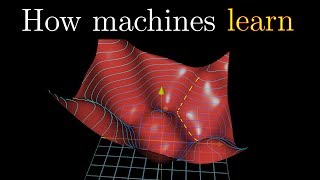
Gradient descent, how neural networks learn | Deep Learning Chapter 2
- Begin with randomly initialized weights and biases.
- Use the downhill direction to reduce cost.
- Explain why continuous activations matter for learning.
Jump to 3:22 random initialization and cost, 7:15 finding the downhill direction
- 7
Advanced, Built from scratch, 2 h 26 min
The spelled-out intro to neural networks and backpropagation: building micrograd
- Build an automatic-gradient engine.
- Represent calculations as an expression graph.
- Apply the chain rule backwards through the graph.
Jump to 0:48 micrograd and automatic gradients, 1:22 an example expression
- 8
Intermediate, How it works inside, 27 min
Transformers, the tech behind LLMs | Deep Learning Chapter 5
- Follow the broad steps of next-word generation.
- Represent words as vectors in an embedding space.
- Distinguish the model’s vocabulary from its learned representations.
Jump to 3:08 how a chatbot generates a word, 3:45 similar meanings in embedding space
- 9
Intermediate, Derivation, 26 min
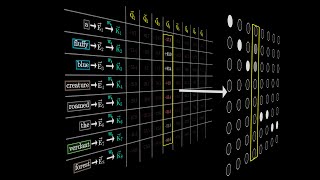
Attention in transformers, step-by-step | Deep Learning Chapter 6
- Recall the prediction goal of a language model.
- Update embeddings using contextual meaning.
- Use queries and keys to ask and answer relevance questions.
Jump to 0:26 the model’s goal, 5:26 absorbing meaning from context
- 10
Intermediate, Visual intuition, 24 min
The Breakthrough Behind Modern AI Image Generators | Diffusion Models Part 1
- Generate images by refining Gaussian noise.
- Locate images and noise in a shared space.
- Separate training from the generation process.
Jump to 0:30 starting from gaussian noise, 4:10 images and noise in the same space
- 11
Advanced, Derivation, 52 min
More Than Image Generators: A Science of Problem-Solving using Probability | Diffusion Models
- Ask why denoising is worth the theoretical effort.
- Connect generative modelling with natural phenomena.
- Interpret sampling as drawing from a probability distribution.
Jump to 0:50 why care about diffusion, 2:17 two facets of one phenomenon