The mathematics of change and signals
How do transformations, rotation and frequency explain systems that change?
13 videos, about 4 h 48 min. Watch in order, or jump to a timestamp.
- 1
Introductory, Visual intuition, 14 min
Dot products and duality | Chapter 9, Essence of linear algebra
- Relate a dot product to projection.
- Understand dot products through linear transformations.
- Connect vectors with their dual transformations.
Jump to 0:34 why transformations matter, 1:30 dot products as projection
- 2
Intermediate, Visual intuition, 17 min
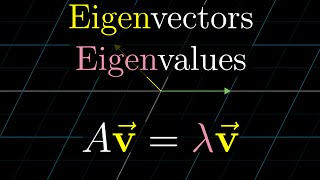
Eigenvectors and eigenvalues | Chapter 14, Essence of linear algebra
- Find vectors that remain on their own span.
- Interpret eigenvalues as stretch or squish factors.
- Use an eigenbasis to simplify a transformation.
Jump to 0:51 prerequisites for eigenvectors, 1:39 most vectors leave their span
- 3
Advanced, Lecture, 44 min
A Swift Introduction to Geometric Algebra
- Introduce bivectors and higher-dimensional primitives.
- Generalize the geometric product.
- Interpret multiplication as rotation.
Jump to 4:32 from scalars and vectors to bivectors, 7:49 k-vectors and the geometric product
- 4
Intermediate, Visual intuition, 32 min
Visualizing the 4d numbers Quaternions
- Treat quaternions as a four-dimensional extension of complex numbers.
- Visualize their behaviour in three dimensions.
- Connect quaternion history and modern uses.
Jump to 0:21 quaternions as four-dimensional numbers, 1:42 hamilton’s push for quaternions
- 5
Introductory, Visual intuition, 27 min
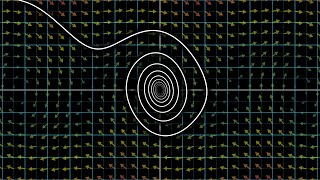
Differential equations, a tourist's guide | DE1
- Describe a system through a rule for change.
- Represent a damped pendulum as a trajectory.
- Use phase space to reason about multi-variable systems.
Jump to 13:04 a damped pendulum spirals inward, 18:03 phase space for several bodies
- 6
Intermediate, Derivation, 4 min
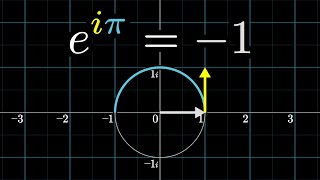
e^(iπ) in 3.14 minutes, using dynamics | DE5
- Define exponential behaviour through a relation between position and change.
- Interpret multiplication by i as a quarter turn.
- Connect circular motion to Euler’s identity.
Jump to 0:20 position and velocity, 1:50 what happens with the constant i
- 7
Intermediate, Derivation, 27 min
How (and why) to raise e to the power of a matrix | DE6
- Recognize that matrix exponentiation is not repeated multiplication of e.
- Define exponentiation through a power series.
- Connect matrix exponentials to systems of change.
Jump to 0:22 why matrix exponents seem nonsensical, 1:24 what the definition is not
- 8
Introductory, Visual intuition, 20 min
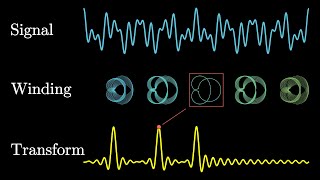
But what is the Fourier Transform? A visual introduction.
- Decompose a sound into frequency components.
- Wind a signal around a circle at different frequencies.
- Use the centre of mass to detect matching frequencies.
Jump to 0:27 decomposing frequencies from sound, 3:47 winding a signal around a circle
- 9
Intermediate, Derivation, 25 min
But what is a Fourier series? From heat flow to drawing with circles | DE4
- Build complicated behaviour from rotating vectors.
- Treat sine-wave decomposition as a special case.
- Use linearity to solve the heat equation with simple solutions.
Jump to 1:31 drawing with rotating vectors, 2:11 context in the heat-equation series
- 10
Introductory, Visual intuition, 23 min
But what is a convolution?
- Introduce convolution as a new way to combine lists.
- Find probabilities for sums by pairing outcomes.
- Relate convolution to image processing.
Jump to 0:20 a new way to combine lists, 3:04 flipping and sliding dice outcomes
- 11
Intermediate, Visual intuition, 18 min
The intuition behind Fourier and Laplace transforms I was never taught in school
- Interpret transform integrals as real and imaginary areas.
- Relate frequency ideas to exponential behaviour.
- Compare the questions answered by Fourier and Laplace transforms.
Jump to 1:00 integrals as real and imaginary areas, 13:52 connecting to the laplace transform
- 12
Intermediate, Visual intuition, 20 min
What does the Laplace Transform really tell us? A visual explanation (plus applications)
- See how a pure cosine appears after transforming.
- Interpret transformed derivatives algebraically.
- Use transforms to analyze differential equations.
Jump to 1:40 transforming a pure cosine, 14:36 laplace transform of a second derivative
- 13
Introductory, How it works inside, 16 min
Everything You Need to Know About Control Theory
- Capture system dynamics in a mathematical model.
- Use feedback to correct deviations.
- Change system dynamics and stability through control.
Jump to 3:47 modelling system dynamics, 6:21 feedback control